Showing posts with label E. Assignment 4: 3 Minute Wonder. Show all posts

21/06/2013

Window on the World


Is television news a ‘window on the world’?

The starting sequence of the news is the first part we get to see. In terms of watching the starting sequence we get the idea that we are seeing a window of the world through the news. The starting sequence involves many icons, which we associate with the news like seeing the world. After the starting sequence then next part we get to see of the news is the presenters and the set. The set of the news station is key as we get to see it as if we are watching right in front of them so nothing is being kept secret from us and so this makes the news accurate in the sense of that the news channel wants to show us everything possible to make us feel that we are just looking out a window and seeing into the set. When we hear the studio news readers talk we understand that the mode of address to the viewer is direct and formal, this presents to us that they are important and accurate and they have important information to inform us about.

 Television should be presented with a balance of good news and bad news as people like to find out about people who have died, and as the program should be laid out in a way that the hard hitting stories are first and gently getting better to hear about for example from a murder to a lottery winner. Also it shouldn’t be presented in a biased way. The presenters do not show any emotion or there opinion towards any of the news as this will manipulate our views on it, so the presenters should be objective an present the news so if we saw it through a window, no views except out own. This links to impartiality as the news channel doesn’t want to broadcast news that will affect a person views on the subject for example broadcasting news that affects the views of a religion. Ofcom provide this definition of Due Impartiality "Due" is an important qualification to the concept of impartiality. Impartiality itself means not favouring one side over another. "Due" means adequate or appropriate to the subject and nature of the programme, Ofcom are putting across that you can put the opinion towards the subject only if it is appropriate. Legal issues are the main part producers have to take in before they can broadcast the news and the impartiality of the news is one of the main things to look out for as if the news would put their views on top of the news we wouldn’t be watching the news as it is a window on the world. There are many other laws to follow like the Prevention of Terrorism Act and the Official Secrets Act, these both are laws that the news channels have to follow as they could put the security of the nation in danger.


 So to regulate the news there are regulatory bodies, two of these are Ofcom and the BBC. Ofcom and the BBC both are regulators but Ofcom is the main regulator, Ofcom regulates TV, Radio, Mobiles and postal services. The main purpose of the BBC is that it is a public broadcasting service.

 There are many ways that the news can be selected to be broadcast. A story must contain enough of the Galtung and Ruge’s new values to even get a chance to be broadcast, a few of these news values are Elite Persons, this means that the news has to include someone that is important to us. A more frequent new value is Negativity as people like to be informed about bad news and bad news is good news. Another way a story can be selected is by the Economics of the news production, at the start of the financial year for the production teams they get allocated a budget and the team have to decide which stories they would like to cover better by having more money. An example of this is at Tiananmen Square in 1989 when the protests where ongoing the BBC and ITV had to decide whether to spend a lot on this and the BBC did and had a better story on the news which had links to the studio and field reporters on scene instead of just having a reporter on the phone.

This links to another point of selection, the BBC and ITV know how worthy the news will be as they compare to their competition and they compare how the story is presented as one may use experts and witnesses of this news whereas one won’t. After the news has been selected the team will have a team there to film the selected news and when the team have finished filming they need to construct the news and they construct this news by either two ways of narrativisation, they both have the same structure but they are expressed from different angles, one has normality and then a sharp enigma and then a smooth path to resolution and finally a closure whereas the other has a Hero and a Agent of change and then the quest is created and finally a closure. This is like a window on the world as if we were watching for example a house fire out of our window we know the normality before it happened, then we see the house on fire, then the fire brigade turn up to put the fire out and finally we end with a smooth closure everyone is safe and the fire is out. Another construction technique the editors can use is hiding the constructed nature of the text, in another way of expressing this is realism of the footage, when we watch news we see some scenes, where you see the reporters interviewing someone then they cut to a picture or video of what the person is relating too while they have the voice over the top of the video, this hides the person talking about that subject so we don’t get to see their feelings, we are just focused on one subject eg: a photo. This is not as real as we would see this through a window and so this puts a negative point towards us that the editors are trying to manipulate us. Most editors describe actuality footage as a building block to creating the news as they edit the original footage to manipulate us. This is not a sample of reality but in fact far from it, as the person who is watching can tell that the video footage has been selected and edited together to create a viewpoint that the editor wants to put across.

Overall the news report structure is key to us as we can determine whether this is a window on the world and how well the representation of this news is put across. I believe that that most of the points put across matter as without all the news values/ structure and the construction we would not understand and therefore we would not have and interest in the news. In some ways we can’t do anything about how the news is presented to us as it is the broadcasters choice how they want their news to be seen. The only way we can do something about the news is by reporting parts to Ofcom and they will try to regulate this, I believe the only way this could be report is if the news is impartial and does harm people views towards things.

Many news reporters say now that it is not them who collect and find the news that it is the general public as now our generation is heavily involved with technology so people will broadcast their findings on social networking sites and blogs. The main social networking site that reporters believe is helping them is Twitter as people put across their own opinions from their finding and this can help the editors while creating a news package. Its not just the evolution of social networking sites it is also how technology in phones is developing and if you saw someone or something you would more than likely take a photo of this happening which also helps the editor create their news package. I believe that this does make a difference to how the news is presented as this is saying anyone can create the new effectively so it is more understandable that the news is a window on the world as anyone can create the news.

04/06/2013

Documentary Mini Task

Introduction
A documentary is a type of a media product where the director captures a 'aspect of reality' to keep for historic or informative purposes. A documentary can be either displayed by film or by television, and there are five different types of documentaries to offer for a user. Some documentaries may be more authentic than others and this leads to why some are heavily criticised, as they are either misleading or aim to offer only one opinion towards the subject.

Expository Documentaries
The first documentary type is "Expository', the type of documentary is when there is a 'Voice of God' talking directly towards the user trying to express one opinion with a strong argument. The voice is normally a male with a rich tone like David Attenborough. The main conventions are normally facts, opinions, rhetorical questions and persuasive techniques. An example of an expository documentary is on channel 4 and is called Dispatches, in the post office undercover episode we hear the narrator express his views towards how the 'Royal Mail' are treating our post and manipulates the video with his rhetorical questions, one of these is "Should our mail be privatised'.

Observational Documentaries
An observational documentary is one which the film maker doesn't get involved with the actual footage for example in 'One Born Every Minute' the film maker is just in a hospital to record what happens, without any interviews or narration. The dispatches documentary had stages pf which it could be observational as parts there are hidden cameras and we see how the people in the sorting factories are treating are treating our mail. Observational documentaries could be based on war, social life, bullying and many more things but most are done on our social life as we see how people are carrying out certain activities. The authenticity of the footage could be judged as in observational documentaries you see the camera and you see that some of the people in the video are playing up to the camera as it is in view whereas it would be different if the cameras were hidden.

Interactive Documentaries
The interactive documentary is when the the film makers perspective is more evident as we see them on screen and this allows the film maker to explain more in detail and explain his facts and opinions by backing them up. The interactive documentary is the more 'liked' documentary in my opinion as people do like seeing people addressing them in a sense of that David Attenborough has carried out a lot of interactive documentaries. David Attenborough's documentaries have shown that he is interactive when producing, but he has a very different style to be interactive. 
Access and privacy can affect the production of all media products, as we can't either use other peoples material or we can't go into a unsafe area without permission.
Ofcom Has regulations on Privacy and these are two of many, which state that you can't use or disclose people without their permission.
8.2 Information which discloses the location of a person's home or family should not be revealed without permission, unless it is warranted.
8.3 When people are caught up in events which are covered by the news they still have a right to privacy in both the making and the broadcast of a programme, unless it is warranted to infringe it. This applies both to the time when these events are taking place and to any later programmes that revisit those events.
The legal obligations of media products can have a massive effect on production being shown on TV as the BBC and other companies have to regulate so they don't get large fines. In an interactive documentary you see the presenter, this makes the audience believe what is happening more believable as you see just a normal personal interviewing people without the footage being manipulated and with the presenter expressing his/hers views towards the subject helps us believe it. Also an interactive presenter could be more believable as if you like them already, so you know that they have done recent ones in the past and you liked them, you are more likely to believe what they say as you feel they done it well the first time.

Reflexive Documentary 
The reflexive documentary is where the film makers presence is clearly in front of the camera (Shows how the documentary is constructed) and in someone ways it could be portrayed that the interviewer integrates some of the interviewees, as one of the well known reflexive film makers "Louis Theroux" had done many reflexive documentaries. As he is very well known for asking the questions that no one wants to ask. I believe these type of documentaries are very authentic as you see exactly what the interviewer is saying without manipulating the text. One of 'Louis' series which was popular was 'Louis and the..." this documentary was very well reviewed as he went into some rough areas with different types of people to ask them questions. The idea of a reflexive documentary is that you get the exact view from the camera without it being manipulated. One of the first reflexive documentaries was 'Man With A Movie Camera' and this included footage of the film maker in the film, in the 50's reflexive documentaries became more popular as portable cameras could be used and this made the audience feel that they are exactly behind the camera. 

Performative Documentaries
The key feature of performative documentaries are the re-enactments of the subject. I believe that the re-enactments really do interest the user when watching as it gives a insight of what would have happened. The performative documentary is expressed so it encourages the user to fell how they would have felt and makes us feel if the events are manipulated to make one opinion come across more than another. An example of an Performative documentary is Air Crash Investigation, this documentary is a building one of which the whole way throughout it, it is building on its own story, we see many re-enactments during the media and we see people on both sides of the investigation from the investigators to the family of the deceased. The implication of using re-enactments is that some may be used incorrectly, in the way which they may be there to express how someone saw it and it was actually a lie , as people have lied to get the bounty money for example in "Thin Blue Line". I believe that re-enactments attract people as it feels that we are getting a sneak peak of what happened and this makes me feel that they attract more people to watch it. 

Conclusion 
I believe that some documentary types are there to manipulate your view of something and that is why I only like documentaries that are showing the real raw footage. I particually like perfomative documentaries as i feel that you are effectively getting a exclusive view on what happened. The thing that I think is wrong with documentary making is, manipulation - Some documentary types manipulate your views by either the interviewer or by the editing techniques, a way which the editing can manipulate us, is by displaying more of one person than the other or hearing only his/her opinions on a certain point. The best thing a documentary can do I believe is show the video without it being manipulated or editied, like in reflexive documentaries you see exactly what is happening with no edits, like in war documentaries a lot of people watch these as they know that they won't be changed in anyway. Also a lot of people like to watch observational documentaries and like 'One Born Every Minute' you can tell that these are not edited in anyway to manipulate our views, they are there to show us what is happening. Overall a perfect documentary to me is one which is not manipulated and not edited (so it shows all the raw footage).

30/04/2013

Pre-Production

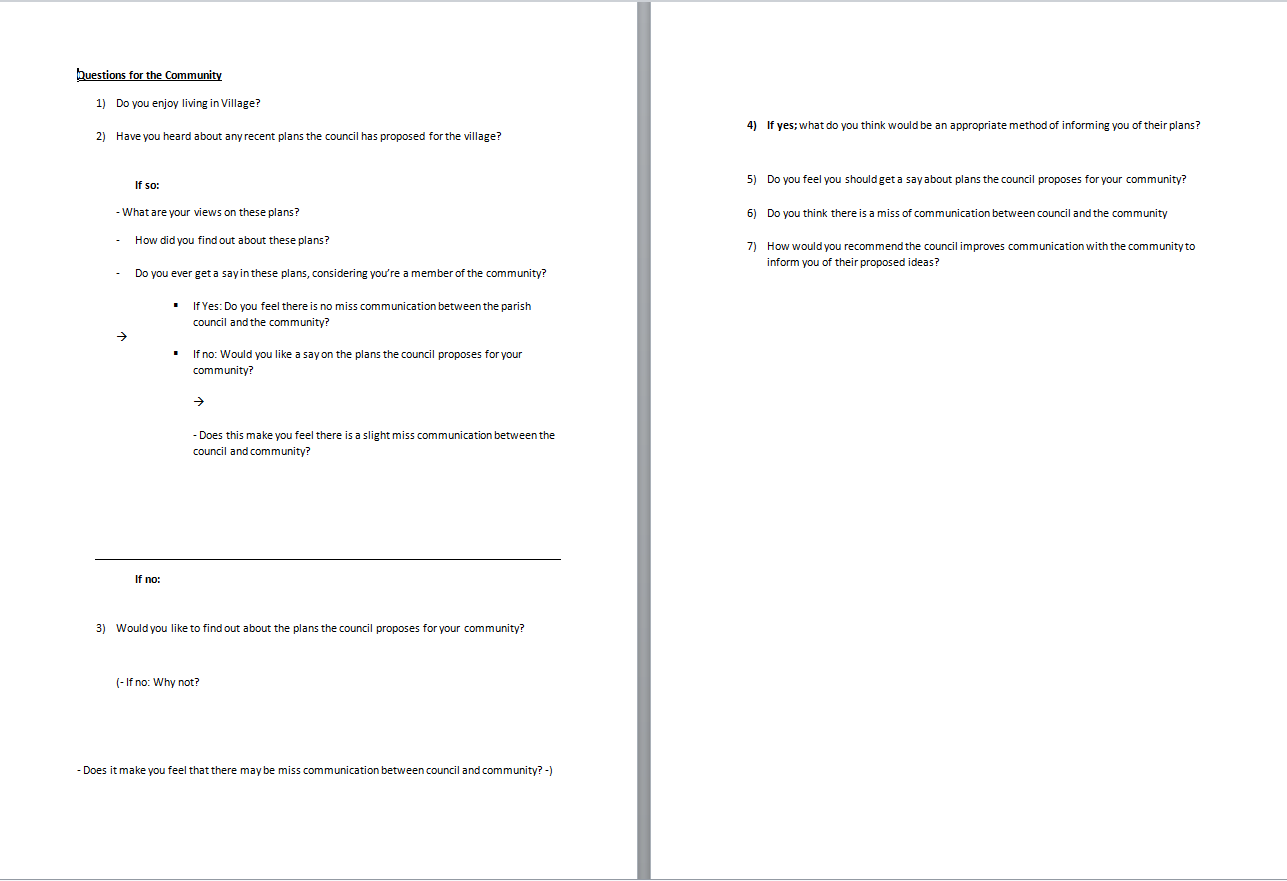
Risk Assessment                                                                                             Questions


24/04/2013

Initial Planning

Our proposed idea for our documentary is to inform the person who will be watching it what is happening in Belton. So this documentary will show you all the developments in the village like making a skate park, having a public field and investments by the council in Belton to make the villagers lives better. Our documentary will include interviews with the general public in Belton and the parish council in Belton. In the documentary there will also be pictures of the plans for Belton as well as pictures of what Belton used to be like and how it has changed in the years.

Our primary audience is adults who live in the area and our secondary audience is adults who are looking to move into Belton or who are looking to go on holiday in Belton. The aim of this documentary is to inform the user about Belton for example what facilities we have and what holiday camps we have etc. The format we have chosen for this documentary  is expository as we want a voiceover for  the images and film and this format suits it best as we don’t want to get heavily involved like the Interactive format but we want some involvement.  With our documentary I don’t believe there will be any technical or ethical problems but I believe that because we have a limited budget we won’t be able to do as much than if we had more money. They may be legal issues in the point of filming the general public.
*UPDATE*
We have changed our idea now so that we are focus on 'Is there a miss communication between councils and the community?'. This allows us to focus on what people are informed about what their council is doing. When we were trying to organise the interviews and the filming of the council meeting, we found out that we wont be able to film the council metting so instead we had an idea of filming the councilers going into the building and going out of the building.

3 Minute Wonder

http://www.channel4.com/programmes/3-minute-wonder/4od#series-15

This 3 minute wonder is about a man who has a serious condition which normally doesn't allow him to perform certain activities but from his childhood Ben Cove started painting and he is not giving up on his hobby just yet. He focuses his painting on Superman and Christopher Reeve who is now a paralysed actor.

http://www.youtube.com/watch?v=sMq7NrgE8AA

This 3 minute wonder is about Belachew Girma who is the world champion for the longest laugh and his task is too cheer up Walsall as they are said to be the most unhappiest place to live.


23/04/2013

3 Minute Wonder Individual Ideas

The two ideas I have come up with are :

1) New Road playing field in Belton, to make it a public field - Interviews with peoples different opinions, News articles etc

2)  A new proposal for another playing field in Belton for a skate park - See what the plans are for the projext, who will like it who won't, discuss with the people who made the decision for this.

13/04/2013

News Programme Assessment of Values

1.Plane Plunges Into Water Near Bali Airport 
-The Visual Image - Seeing a plane in the water and knowing more than 100 passengers were on board.
-Threshold- how many people where on board frightens people to think if anyone survived
-Negativity- A plane crash is bad news for people to hear about but they want to hear how many people survived
Source: Airport, Police
2.North Korea Alert After Japan Blunder 
-Elite Nations- As the USA and North Korea are preparing for a war, Japan hit the headlines as they sent a message out saying a missile has been launched when in fact it was a message that was supposed to be about an earthquake.
-Threshold - The size of the arguments going on between USA and North Korea make the headline bigger.
-Continuity- More developments on the current arguments between the countries
Source: Government Departments, Army, Navy, Airforce
3.Thatcher : Daughter Carol's Personal Tribute 
-Elite Person- The importance is that our only female PM has died 
-Continuity- Everyday since Margret Thatcher died more developments of the story have occurred, people opinions.
Source: Governments Departments, Royalty
4.Five Dead In Crash Between Lorry And Car
-Negativity- It is bad news as people have died in a car crash 
-Meaningfulness- People care about other people dyeing
Source: Police, Other Emergency Services 
5.US Urges China To Help End Crisis 
-Meaningfulness- How meaningful this is to the current things that are happening in the world
-Continuity- We receive more updates on the developments of the USA vs North Korea everyday
-Threshold- The size of the stories which involve USA and North Korea as it could end with a war
Source: Government Departments
6.Measles: Row Erupts As Cases Increases 
-Negativity-Bad news as this is putting people in danger 
-Meaningfulness-Putting people in danger 
Source: Parliament, Other Emergency Services 


25/03/2013

News Channel Intro

Sky News :
http://www.youtube.com/watch?v=yR-BDu5D8f8


Iconography of Tv News
The first thing we see as the intro for sky news is a view which looked to be like from a satellite, this shows the sky news title as well as a globe, so this is showing the world from space.

The next shot we see is a overview of the newsroom, this continues to be the main part of the intro and as our view is rushing through the studio this could suggest we are the news as we go through the camera, and this is a part of the iconography of a news channel as the camera movements are rushed.
We then see the shot of the camera, this could be the first part of technology we see and this makes the newsroom look very modern with the lighting. Over the top of the camera movement we hear some music which is fast paced suggesting that the news is given to us as quickly as possible.
Next we have a shot which shows a group of people talking and this is the first time we get to see the faces of the people and how they react but I feel the whole idea of this intro is showing us how the news is brought to you.

The things we don't see in this intro are transparent objects, this would be good if the producers used transparent object as it suggests we see the news through them. We also don't see any landmarks or phalic symbols, normally we at least see some landmarks of the main cities as they are the most important things about the news, where it is happening. We also don't hear any voiceovers, normally we hear a male voiceover as it goes into the studio.

The only graphics we see are the sky news title come onto the screen.


News Reporter Analysis:


The first shot we see once we are in the newsroom is the newsreader looking directly towards the camera, this makes you feel like he is talking to you. The first thing we hear from the newsreader is the date and then he says 'a very good morning to you' this mode of address is welcoming as once again it makes you feel as he is talking directly to you.
The presenter 'Eamonn Holmes' is also looking formal as he is wearing a buisness suit which clarifies that this will be serious and important.


We then see a the main topics while we are getting a voiceover as well. Normally we don't have presenters with strong accents like Irish but the presenter makes the accent clear, we normally have a presenter with a standard English dialect.


We also see that the presenter is sitting behind a desk, this connotes urgency and importance to the viewer. The presenter is also a middle aged man at 48, which is normal for male presenters as it connotes wisdom and authority whereas if the presenter was a female she would be in the early 30's and would be normally used because of the sexual attraction to her. The presenter also shows no emotion towards the story he is reading so this doesn't give a biased opinion towards the viewer.


Mise-En-Scene Analysis:
In a newsroom we normally see a desk which the presenter is sitting behind. On the desk we normally see notes for the newsreader to read and a laptop. The reason for a laptop maybe that is shows that they are using all the technology possible to get the news to the people. A method adapted by a few news channels now is too see the TV control studio behind the presenter, maybe this is used so the viewer can see the people working to get the news to you as quickly as possible.